
Your BACOENG vacuum pump is running, but the gauge shows no pressure building — a frustrating situation that stops your project cold. The good news is that vacuum pump running no pressure issues are almost always fixable with systematic troubleshooting. Most problems stem from valve positioning, gasket leaks, or incorrect startup procedures rather than pump failure. This guide walks you through five diagnostic checks using your manual’s specifications to isolate and fix the problem.
Why Your BACOENG Pump Runs But Produces No Vacuum
Five reasons a vacuum pump fails to build pressure
When your BACOENG pump motor spins but the vacuum gauge needle doesn’t move, one of these five issues is always responsible:
- Intake valve (hose barb side) is closed — The pump cannot pull air if this valve blocks the chamber connection.
- Vent valve (opposite side) is open — An open vent valve allows atmospheric air to flood back into the chamber, overwhelming pump output.
- Hose connection is loose — A hose that hasn’t slid fully onto the barb creates an air leak that destroys vacuum buildup.
- Gasket or lid seal is compromised — Debris on the chamber rim or an unseated lid lets atmospheric air leak into the vacuum space.
- Pump oil is low or contaminated — Oil below the middle sight glass marking or cloudy oil prevents the pump from creating adequate sealing action.
Difference between no pump output vs. slow pressure buildup
There’s a critical distinction: no pressure at all within 5 seconds indicates a valve or leak problem (checks 1–4), while pressure climbing very slowly suggests pump degradation or oil issues (check 5). If your gauge shows zero movement after 10 seconds of pump operation, start with valve positions immediately — that’s your fastest fix.
How to recognize if pump is operating properly
A functioning BACOENG pump exhibits these signs:
- Motor runs smoothly without grinding or unusual noise
- Oil circulates visibly in the sight glass (slight movement)
- Vacuum gauge needle moves noticeably within 3–5 seconds of startup
- Pressure climbs steadily toward the -27 to -29 inHg range (the acceptable operating window per your manual)
Check 1: Verify Valve Positions and Ball Valves
Why the valve with hose barb must be open
The valve attached to the hose barb on your BACOENG chamber is the intake valve. According to your manual’s Section 4, this valve must be open to allow the pump to pull air from the chamber. When this valve closes, it completely blocks vacuum buildup — the pump runs but accomplishes nothing. Think of it as a gate: if the gate is shut, water cannot flow downstream, regardless of pump power.
Full port ball valve on opposite side must be closed
The valve on the opposite end of the chamber is the vent valve. This valve is intentionally open to atmosphere and must remain closed during vacuum operation. If this vent valve is open, it defeats the entire purpose — you’re trying to remove air from a chamber that’s simultaneously being refilled with atmospheric air. The manual explicitly states in Section 4: “be sure the full port ball valve on the opposite side of the hose barb is closed.”
How to confirm each valve is in correct position
Ball valves operate on a simple rule: the valve handle should align with the direction of flow you want.
| Valve Location | Required Position | Handle Alignment | Purpose |
|---|---|---|---|
| Hose barb side (intake) | OPEN | Handle parallel to hose | Allow pump to pull chamber vacuum |
| Opposite side (vent) | CLOSED | Handle perpendicular to hose | Prevent atmospheric air from entering |
Physically verify each valve with your hand before starting the pump. A quarter-turn of the handle switches a ball valve between open and closed states. If you’re unsure, turn the intake valve handle until it points the same direction as the hose line — that’s open. Turn the vent valve handle 90 degrees away from the chamber opening — that’s closed.
Check 2: Inspect Lid Gasket and Chamber Seal
Debris and dust preventing proper seal
The gasket that seals your chamber lid is typically silicone rubber, and it requires a completely clean mating surface to work. Even a single grain of sand, dust, or dried residue creates a microscopic air passage that bleeds your vacuum. The manual’s Section 4 diagnostic specifically states: “check the gasket and the top edge of the pot body for debris and wipe clean.”
Common culprits include:
- Dust from storage or workshop air
- Dried epoxy, resin, or silicone from previous projects
- Salt or mineral deposits from humidity
- Scratches or gouges on the lid rim itself
How to clean the top edge of pot body
Step 1: Lift the lid completely off the chamber (you may need to first release any residual vacuum by opening the vent valve).
Step 2: Inspect the top lip of the pot body — this is the circular rim where the gasket contacts. Look for visible debris, hardened material, or discoloration.
Step 3: Use a clean, lint-free cloth (microfiber or soft cotton) to wipe the rim thoroughly. For stubborn residue, dampen the cloth slightly with distilled water or isopropyl alcohol. Do not use solvents if your chamber has an acrylic lid — the manual warns that cactus juice, gator venom, acetone, ethanol, and acrylic-based products cause chemical reactions that crack acrylic lids.
Step 4: Inspect the gasket itself. It should be smooth, flexible, and free of tears. If it’s hardened, cracked, or permanently deformed, replacement is necessary.
Proper pressure down on lid to complete seal
After cleaning and seating the gasket, you must press the lid down firmly and evenly. The manual emphasizes in Section 4: “press down on the lid to complete the seal.” This means applying steady downward pressure across the entire lid surface — don’t just press the center. Many chamber designs use clamps or bolts around the perimeter; tighten these in a star pattern (opposite sides alternately) to ensure even pressure. For clamp-style chambers, hand-tight is usually sufficient — over-tightening can warp acrylic lids.
Check 3: Test the Hose Connection
Hose barb connection must be firmly pushed on
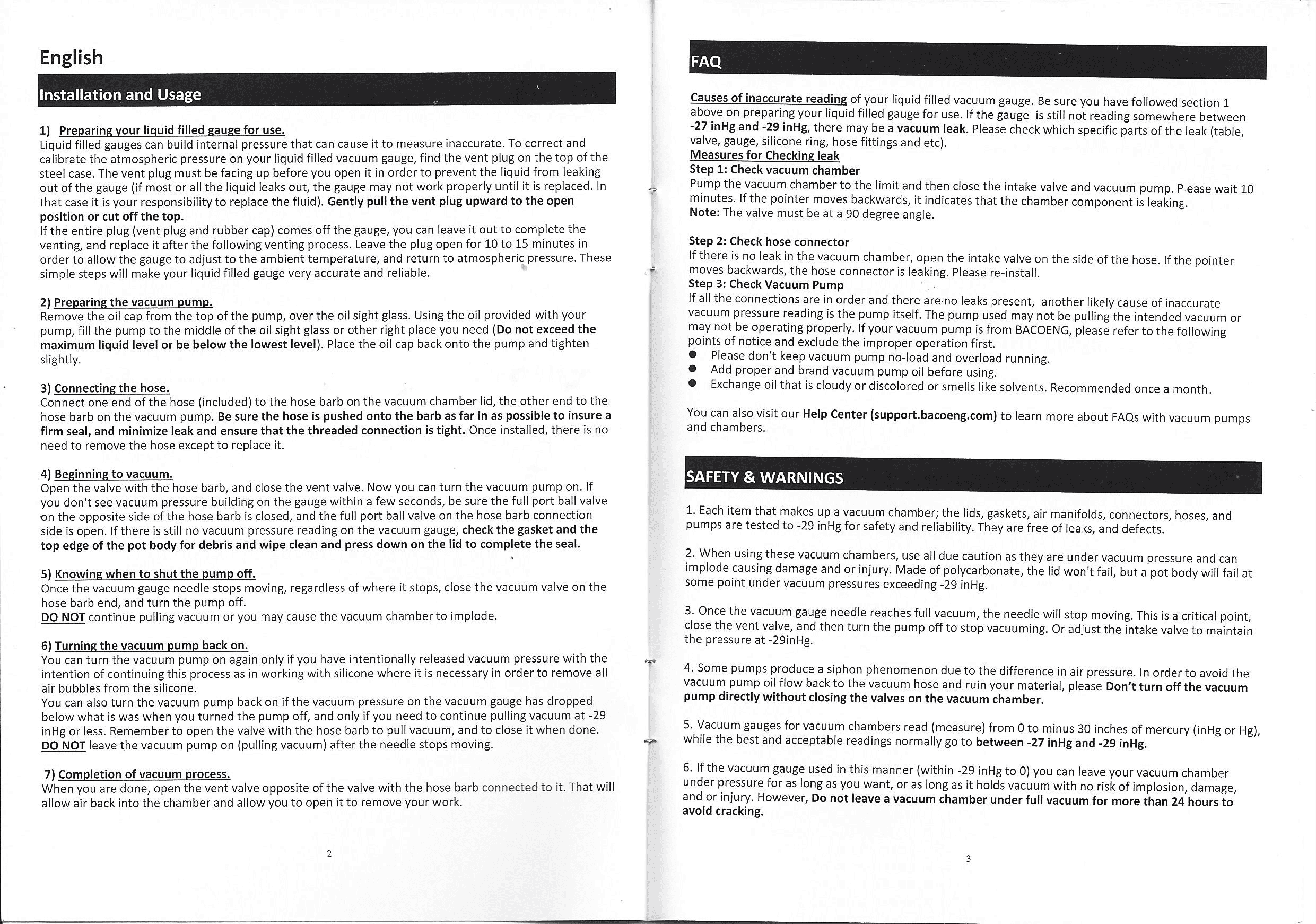
The hose barb connection is a tapered male fitting that your vacuum hose slides onto. The taper creates a friction seal, but only if the hose is fully inserted. Many vacuum pump running no pressure problems originate here because the hose appears connected but hasn’t bottomed out on the barb. Your manual states in Section 3: “Be sure the hose is pushed onto the barb as far as possible to insure a firm seal.”
How far the hose should slide onto the barb
The hose should slide onto the barb until it physically stops — you’ll feel resistance as the barb taper fills the hose interior. A proper installation leaves no visible barb exposed at the hose opening. If you can still see bare plastic or metal barb, the hose needs to go further.
The required insertion depth depends on barb size:
- 1/4″ barb: Hose slides on 1.0–1.5 inches minimum
- 3/8″ barb: Hose slides on 1.5–2.0 inches minimum
- 1/2″ barb: Hose slides on 2.0+ inches minimum
If the hose becomes difficult to move, you’ve reached the taper limit. That’s correct. Stop there and don’t force it further — you risk tearing the hose interior.
Checking for leaks at hose connection point
Once the pump is running, check both hose connections (chamber side and pump side) for leaks:
- Listen for a faint hissing sound near each connection
- Feel for air movement with a wet finger held near the joint (moisture will move if leaking)
- If leaking is confirmed, turn off the pump immediately and reseat the hose by pushing it further onto the barb with a slight twisting motion
- Restart and retest within 5 seconds
If the hose still leaks after full insertion, the hose may be torn internally or the barb may be damaged. Replace the hose (included with your kit) or contact BACOENG support at [email protected] for barb replacement.
Check 4: Verify Pump Oil Level and Condition
How to fill vacuum pump oil to correct level
Pump oil serves two critical functions: it seals internal pump chambers and provides lubrication. Your BACOENG pump cannot build vacuum without adequate oil film. According to Section 2 of your manual:
Step 1: Locate the oil cap on top of the pump, above the sight glass.
Step 2: Remove the cap by turning it counterclockwise (hand-tight removal — do not use tools).
Step 3: Use the oil provided with your kit. Pour slowly while watching the sight glass.
Oil should reach middle of sight glass
The sight glass displays your current oil level. The target fill point is the middle of the sight glass. The manual specifies: “fill the pump to the middle of the oil sight glass or other right place you want (Do not exceed the maximum liquid level or be below the lowest level).”
Why the middle? This provides:
- Sufficient oil to maintain sealing during pump operation
- Air space above the oil to allow expansion and prevent overflow
- Safety margin — over-filling can cause oil to enter the pump discharge line
Step 4: Once filled to the middle, replace the oil cap and tighten by hand until snug. Do not over-tighten; this can strip the plastic cap threads.
Replace cloudy, discolored, or solvent-smelling oil
Pump oil degrades over time and with use. The manual’s FAQ section explicitly addresses this: “Exchange oil that is cloudy or discolored or smells like solvents. Recommended once a month.”
Signs that oil needs replacement:
- Cloudy appearance — indicates water contamination (moisture from humid air drawn into pump)
- Dark brown or black color — indicates degradation from heat and oxidation
- Solvent smell — indicates chemical contamination from your materials
- Visible particles or sludge — indicates oxidation breakdown
To replace oil safely: drain the old oil into a suitable container, wipe the interior of the sight glass with a clean cloth, and fill with fresh vacuum pump oil to the middle mark. Use only vacuum pump oil — do not substitute with general machine oil, engine oil, or other lubricants. BACOENG recommends their branded oil available at www.bacoeng.com (note: the manual mentions saving up to 10% on retail when purchasing directly from the official website).
Check 5: Rule Out Pump Failure
Signs a pump is not pulling adequate vacuum
After confirming that valves are correct, seals are clean, hose connections are tight, and oil is fresh, if your pump still builds no vacuum, the pump itself may be failing. Watch for these red flags:
- Motor runs but no sound from pump head — indicates internal pump damage or seized shaft
- Oil circulates noticeably in sight glass but pressure builds very slowly — suggests worn pump vanes or internal seal degradation
- Pump runs hot to the touch within 30 seconds — indicates excessive internal friction from wear
- Pressure climbs to -5 inHg and plateaus — typical of a pump that’s only half-functional
The acceptable vacuum range for a healthy BACOENG pump is -27 to -29 inHg (per your manual’s FAQ section). If your pump maxes out below -20 inHg after 30 seconds and valve/seal/hose checks all pass, pump replacement is warranted.
BACOENG pump vs. third-party pump considerations
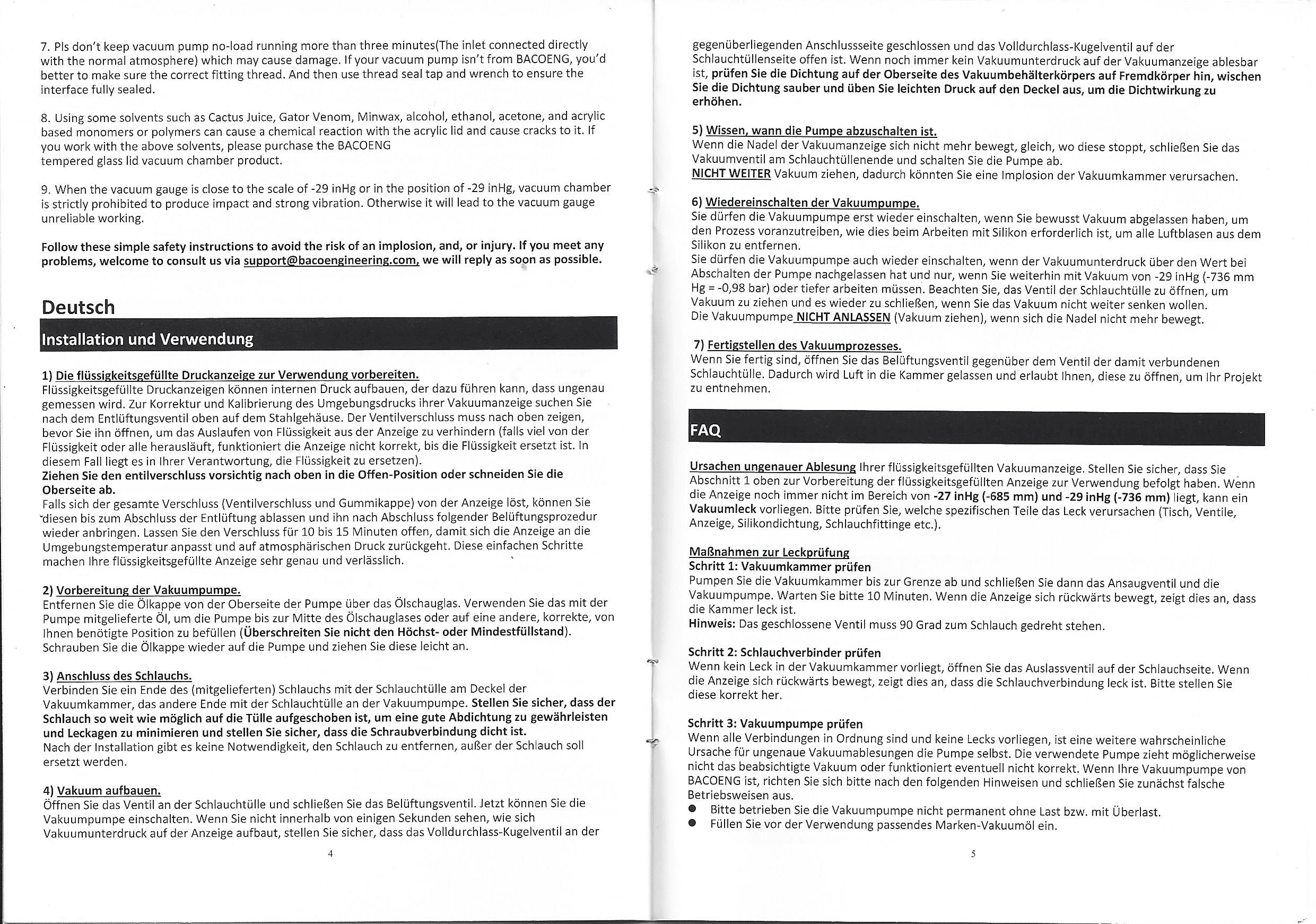
If you’re using the BACOENG pump included with your chamber, the manual’s FAQ Step 3 provides a diagnostic checklist before concluding pump failure:
- Confirm you haven’t run the pump under no-load conditions for more than 3 minutes (see Safety section below)
- Verify you filled the pump with correct vacuum pump oil before first use
- Check that all threaded connections are sealed with thread seal tape (if applicable)
- Ensure no hose or valve connection is leaking back to atmosphere
If you’re using a third-party pump instead of BACOENG’s branded unit, the manual recommends extra verification: “If your vacuum pump isn’t from BACOENG, you’d better to make sure that the correct filling of the pump, and then use thread seal tape and wrench to ensure the interface fully sealed.” Non-BACOENG pumps may require different oil types or have different performance profiles — verify the pump’s specification sheet before assuming failure.
When pump replacement is necessary
Pump replacement becomes necessary when:
- All five checks above show correct setup, yet the pump cannot reach -15 inHg
- The pump runs but produces no vacuum pressure and the oil appears to not circulate in the sight glass (suggesting internal seizure)
- The pump motor spins backward or makes grinding sounds (bearing failure)
- The pump has been run continuously at full load for more than 2 hours (thermal damage)
Contact BACOENG at [email protected] for warranty claims or pump replacement parts. Include details about your checks (oil level, valve positions, chamber pressure limit achieved) to speed diagnostics.
Beginning to Vacuum: The Correct Startup Procedure
Step-by-step: opening valves and starting pump
Your manual’s Section 4 outlines the exact startup sequence. Follow this precisely:
- Verify valve positions: Intake valve (hose barb side) is OPEN. Vent valve (opposite side) is CLOSED.
- Confirm lid seal: Press down firmly on the chamber lid to ensure gasket contact.
- Turn on pump: Start the pump motor. Listen for steady operation — no grinding or stuttering.
- Observe gauge: Watch the vacuum gauge needle begin moving toward the negative (vacuum) side.
- Allow pressure to build: Do not adjust valves or panic if pressure climbs slowly at first — this is normal for the first few seconds.
How long to wait for pressure to build
The manual specifies in Section 4: “If you don’t see vacuum pressure building on the gauge within a few seconds, be sure the full port ball valve on the opposite side of the hose barb is closed.” This means if your gauge shows zero movement after 5 seconds, valve position is your first suspect — not pump failure.
For a healthy system with correct valve setup, expect this timeline:
| Time Elapsed | Expected Gauge Reading | Status |
|---|---|---|
| 0–3 seconds | Needle begins moving left (toward vacuum) | Normal startup |
| 3–10 seconds | Pressure climbs to -10 to -15 inHg | Good progress |
| 10–30 seconds | Pressure climbs to -20 to -27 inHg | Approaching limit |
| 30+ seconds | Pressure stabilizes at -27 to -29 inHg | Target vacuum reached |
What vacuum pressure should appear within seconds
The gauge needle must move noticeably within the first 3 seconds. A completely stationary needle after 5 seconds of pump operation indicates either a closed intake valve or a severe leak. Immediately:
- Turn off the pump
- Double-check the intake valve is open (handle parallel to hose)
- Visually inspect all hose connections for obvious gaps or dampness
- Restart and retest
If the needle moves but very slowly (taking 60+ seconds to reach -10 inHg), your system is likely leaking. Proceed to leak diagnostics using the manual’s FAQ section (covered in Check 2 above).

Critical Safety: Never Leave Pump Running Without Vacuum Movement
Why no-load pump operation is dangerous (3-minute maximum)
A critical safety point from your manual’s Section 7: “Pls don’t keep vacuum pump no-load running more than three minutes (The inlet connected directly with the normal atmosphere) which may cause damage.”
No-load operation means the pump is running but not actively pulling vacuum — either because the intake valve is closed or because the chamber has already reached maximum vacuum and the needle has stopped moving. Under no-load conditions:
- The pump rapidly builds internal heat (no cooling air flowing through the pump head)
- Oil circulates but cannot cool adequately
- Internal pump vanes may warp or crack from thermal stress
- Oil can break down, losing viscosity and sealing ability
The three-minute limit is absolute — set a timer if necessary. After three minutes of pump running with a stationary gauge needle, you must turn off the pump.
Risk of pump damage from extended running
If you accidentally leave a BACOENG pump running under no-load for 5+ minutes, you risk permanent damage:
- Vane damage: Internal vanes crack and the pump loses compression ability
- Oil degradation: Overheating causes oil to carbonize, leaving sludge that jams the pump
- Motor burnout: Excessive current draw without the cooling effect of air movement can overheat motor windings
- Bearing wear: Lubrication fails and bearings seize
Damage from no-load operation is typically not covered under warranty because it represents user error rather than manufacturing defect.
Proper shutdown procedure for failed vacuum operations
If your pump runs but the gauge never shows rising pressure (indicating a failed vacuum operation), follow this safe shutdown sequence:
- Turn off the pump immediately. Do not let it run more than 3–5 minutes.
- Open the vent valve (the one opposite the hose barb) to release vacuum pressure and allow air back into the chamber.
- Wait 30 seconds for any residual pressure to equalize.
- Close the intake valve (hose barb side) to prevent backflow when you remove the hose.
- Remove the hose from the pump barb by twisting slightly and pulling straight off.
- Inspect the hose for cracks, splits, or internal tears. Replace if damaged.
- Perform the diagnostic checks above to identify the cause.
After identifying and fixing the problem (most commonly valve position or hose seating), you can safely restart the pump for another attempt.
FAQ
Why does my vacuum gauge show 0 inHg but the pump is running?
A gauge reading of zero while the pump runs almost always indicates the intake valve (hose barb side) is closed. Turn that valve handle until it’s parallel to the hose line, then restart the pump. You should see needle movement within 3 seconds. The second most common cause is the vent valve being open — turn the opposite valve handle 90 degrees away from the chamber to close it. If you still see no movement after correcting both valves, your hose is likely loose on one of the barbs; push it further on until it stops, then restart.
My pump builds pressure to -10 inHg then stops climbing. Why?
Pressure plateauing below -15 inHg indicates a leak somewhere in your system. The manual’s FAQ outlines a three-step leak diagnosis: First, pump to the limit, close the intake valve and pump, then wait 10 minutes — if the gauge needle moves backward, your chamber is leaking (check gasket and lid seal). Second, if the chamber holds vacuum, open the intake valve with the pump off — if the needle moves backward, your hose connection is leaking (push hose further onto barbs). Third, if neither leaks, your pump may be worn. A healthy BACOENG pump reaches -27 to -29 inHg. If it plateaus below -20 inHg after oil and valve checks pass, consider pump replacement.
Can I leave the pump running while I work on my project inside the chamber?
No. Once your gauge needle stops moving (indicating maximum vacuum is reached), you must turn off the pump immediately. The manual states in Section 5: “DO NOT continue pulling vacuum or you may cause the vacuum chamber to implode.” Continuous pumping past the vacuum limit subjects the chamber to pressure beyond -29 inHg, which can cause the pot body to implode and cause injury. If you need to continue working inside the chamber, close the intake valve (hose barb side) to lock in the current vacuum, perform your work, then reopen the intake valve only if you intentionally released pressure and need to re-establish vacuum.
I smell solvent coming from my pump oil. What should I do?
Solvent smell indicates chemical contamination — you’ve likely been working with volatile materials (acetone, ethanol, epoxy solvents, etc.) that have mixed with your pump oil. According to the manual’s FAQ: “Exchange oil that is cloudy or discolored or smells like solvents.” Stop using the pump immediately and perform an oil change: drain the old oil, clean the sight glass and filler cap, then refill to the middle mark with fresh vacuum pump oil. Going forward, if you work with solvents regularly, plan to change pump oil monthly. Also note: the manual warns that solvents like cactus juice, gator venom, minwax, ethanol, acetone, and acrylic-based materials chemically react with acrylic lids and cause cracks — if you frequently use these materials, consider upgrading to a BACOENG tempered glass lid chamber.
How long can I safely keep a vacuum sealed in my chamber?
Your manual states in Section 6: “Do not leave a vacuum chamber under full vacuum for more than 24 hours to avoid cracking.” This applies specifically to acrylic lids. The extended vacuum duration (beyond a few hours) places continuous stress on the lid material, and acrylic can develop stress cracks that eventually fail. If you need to maintain vacuum for longer than a few hours, periodically (every 6–12 hours) open the vent valve to release pressure, wait 30 seconds, then close the vent valve again. This relieves stress on the lid. For projects requiring vacuum longer than 24 hours, use a BACOENG tempered glass lid chamber, which is not subject to stress cracking.