
Common leak sources: tank, connections, and valves
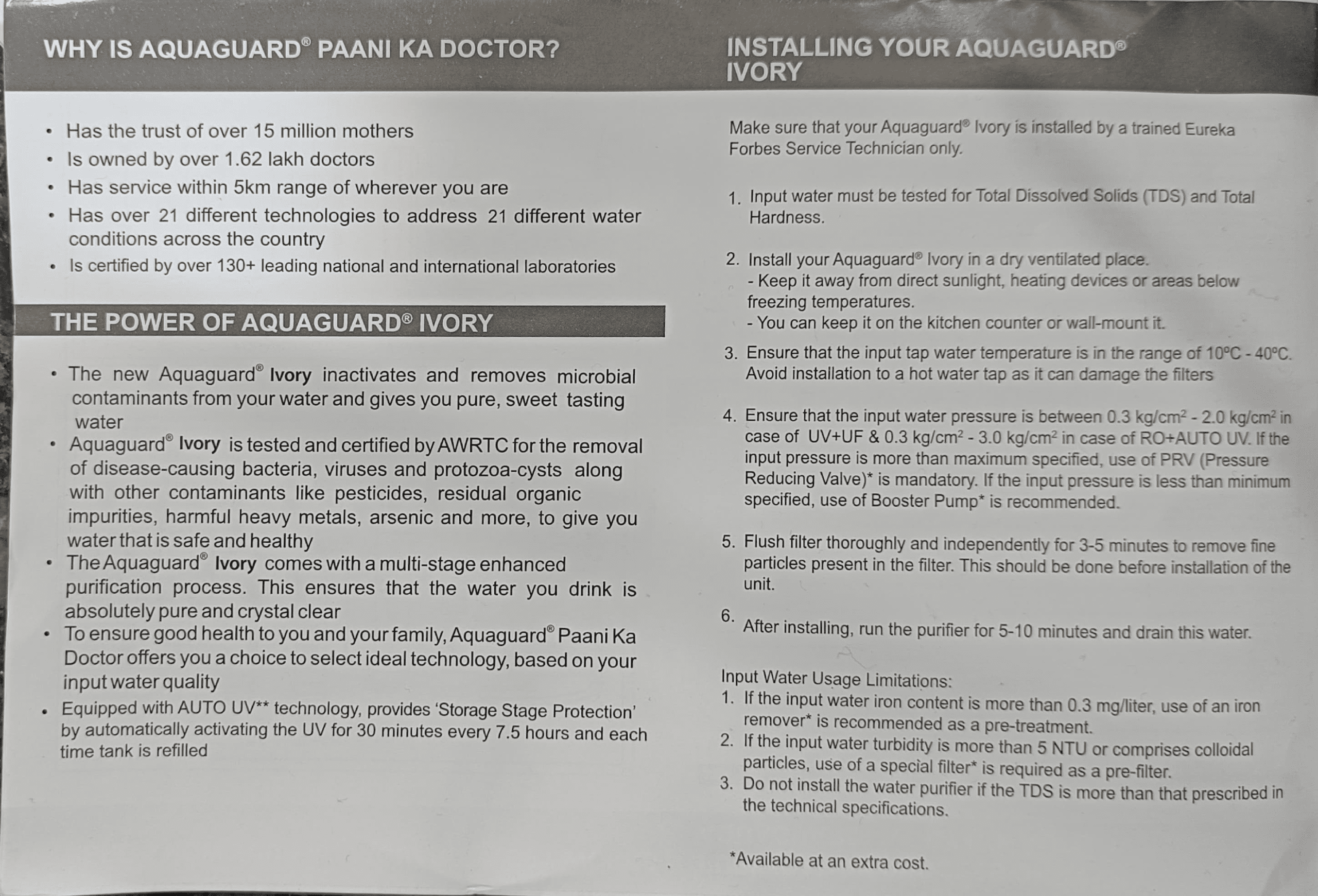
Your Aquaguard Ivory water purifier leaking is almost always caused by one of three things: loose fittings at connection points, a damaged storage tank seal, or a faulty solenoid valve. The Aquaguard Ivory has a 7-litre storage tank and multiple water connection points where leaks develop most frequently. The inlet connection where water enters from your main supply, the outlet connection where purified water flows to your tap, and the internal tank seal are the primary culprits. A defective solenoid valve—which controls water flow into the tank—can also cause persistent dripping or pooling water beneath the unit.
Impact of water leaks on purifier performance and home
Beyond the obvious waste of treated water, a water purifier leaking from your Aquaguard Ivory damages your home. Water pooling under the unit can cause electrical hazards when the purifier is plugged into a 230 VAC power supply. Moisture seeping into cabinetry warps wood and promotes mold growth. Leaks also indicate that the purification system isn’t working correctly—if water escapes from seals, contaminated water may bypass your filters entirely. The manual explicitly states that if you notice water leaking, you should close the water outlet, unplug the power cord immediately, and contact an authorized Eureka Forbes Service Technician.
Quick Diagnosis: Identify Where Water Is Leaking
Top of purifier leaks: Causes and immediate fixes
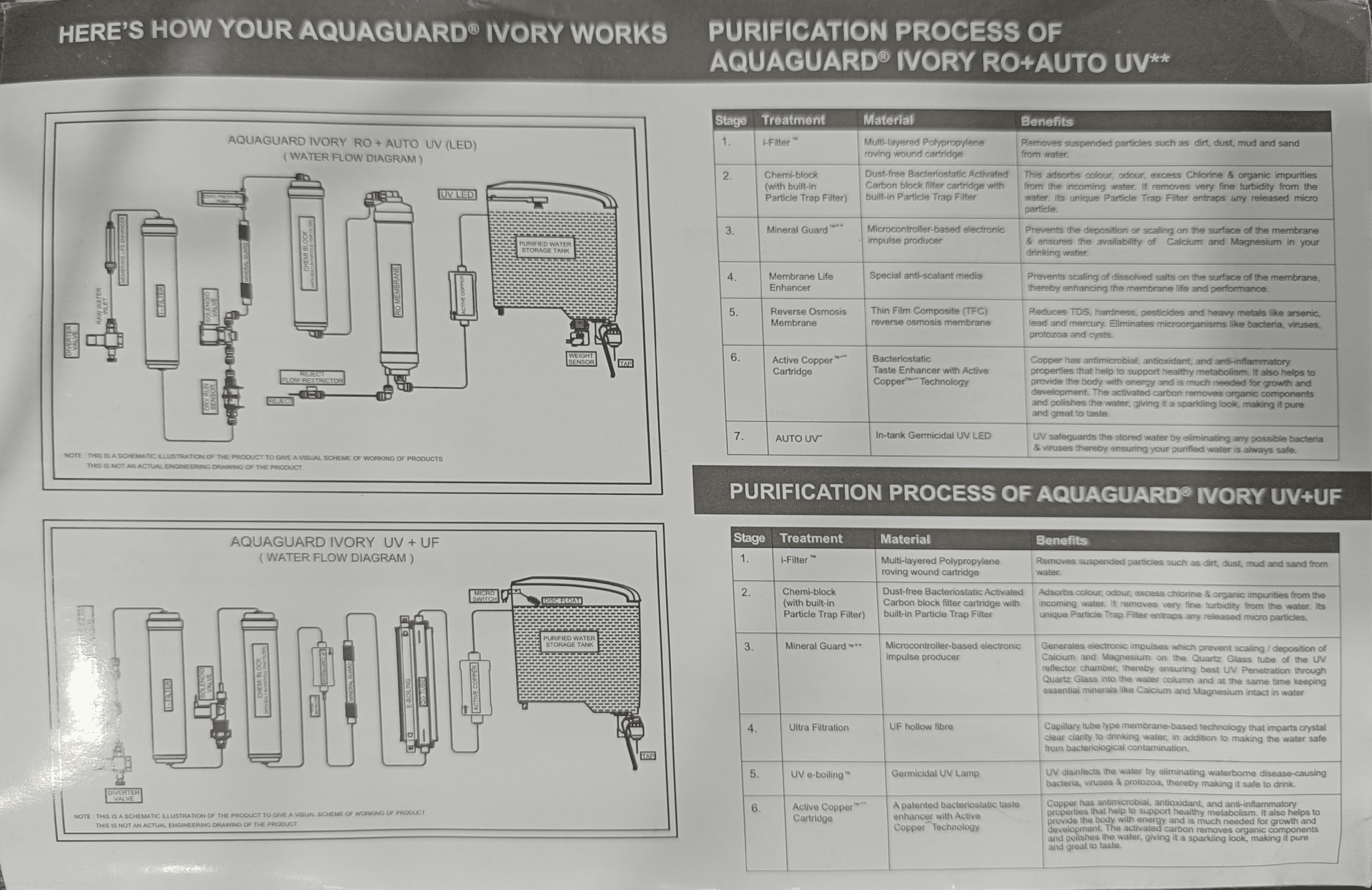
Water leaking from the top of the Aquaguard Ivory typically means the storage tank is overfilling or the tank lid seal is damaged. The tank holds 7 litres and has an automatic shutoff mechanism that should stop water flow when full. If water overflows from the top, the inlet solenoid valve may be stuck open, preventing the tank from shutting off during the filling cycle. Check if the tank is actually full—sometimes the auto shutoff fails due to mineral deposits or debris blocking the valve seat. Try closing the main water supply valve for 30 seconds, then reopening it. If water still leaks from the top, the solenoid valve needs replacement.
Another cause is a cracked or warped tank lid. Inspect the rubber gasket that seals between the tank and the lid. If it appears flattened, cracked, or discolored, it’s no longer creating a watertight seal. The gasket should be soft and pliable—if it feels hard or brittle, it has deteriorated and must be replaced by a service technician.
Tank connection leaks: Pressure and seal issues
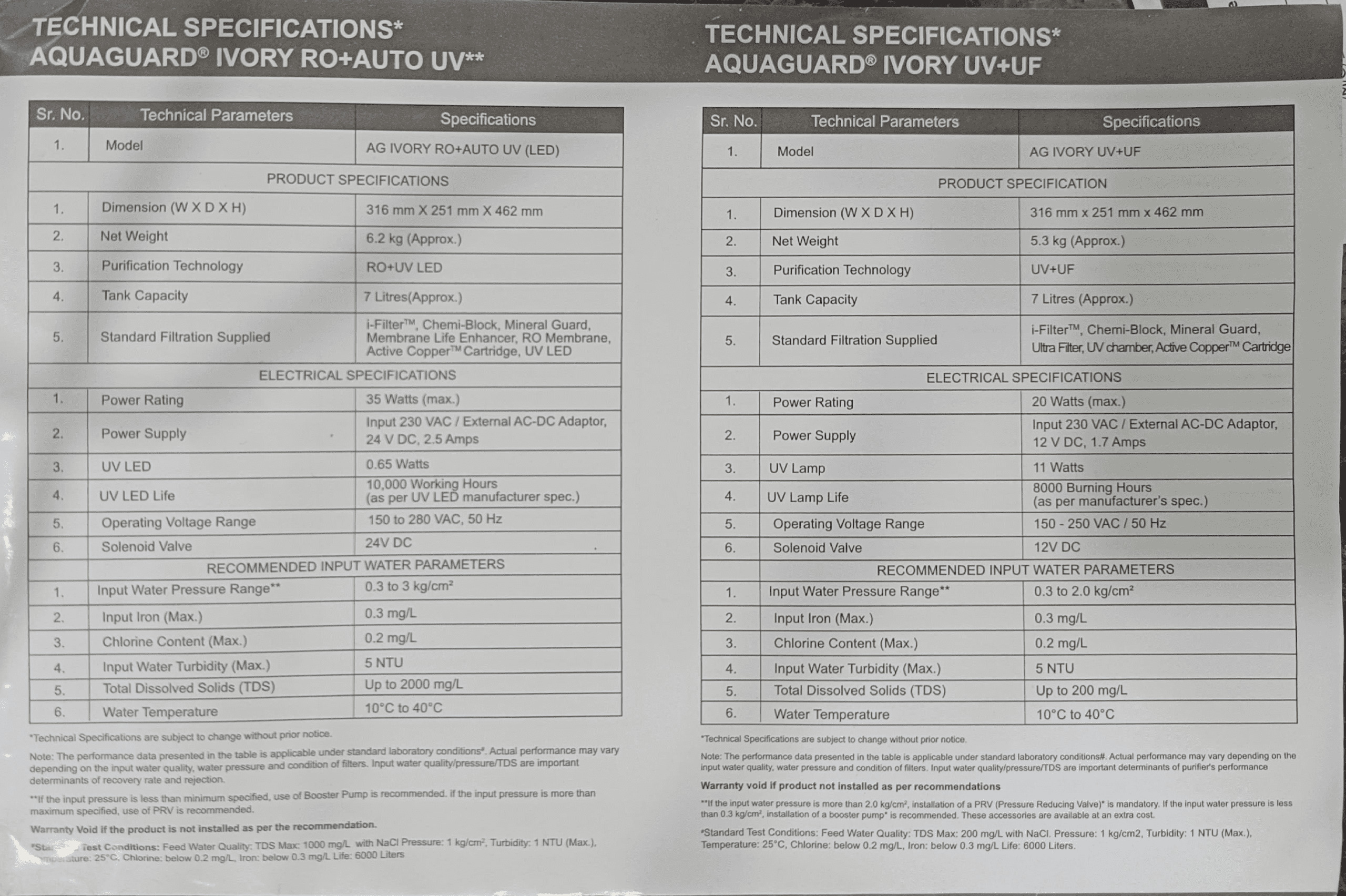
Water leaking from the sides of the Aquaguard Ivory where pipes connect to the storage tank indicates loose fittings or failed seals. The manual specifies that input water pressure must be between 0.3 kg/cm² to 3.0 kg/cm² for the RO+AUTO UV model and 0.3 kg/cm² to 2.0 kg/cm² for the UV+UF model. High pressure stresses the connections and can force water out around the threads where pipes screw into the tank.
Turn off your main water supply and locate all connection points on the tank. Using an adjustable wrench, carefully tighten each fitting by turning clockwise one-quarter turn. Do not over-tighten—you only need hand-tight pressure plus a gentle wrench turn. If water still seeps after tightening, the O-rings or washers inside the fittings have failed. These are internal components that require disassembly by a trained technician. If your water pressure exceeds the maximum specification, you must install a Pressure Reducing Valve (PRV) before the purifier inlet. High pressure is one of the most common reasons for connection leaks.
Outlet tap leaks: Valve problems explained
The outlet tap where you dispense purified water may drip constantly or leak from the base of the tap itself. A dripping tap valve usually means the internal valve seat has mineral deposits or the valve seal has worn out. Calcium and magnesium from hard water accumulate inside the valve over time, preventing it from sealing completely. The quick fix is to close the outlet tap firmly—but not with excessive force—and check if dripping stops. If it continues, the valve cartridge needs replacement.
If water leaks from the base where the tap connects to the unit, the compression fitting or the tap’s internal seal has failed. Try tightening the nut at the base of the tap using a wrench, turning clockwise slowly. If the leak persists after tightening, the tap assembly must be replaced. This is not a DIY repair—contact your nearest Eureka Forbes service center.
Step-by-Step DIY Water Leak Solutions
Emergency shutdown procedure
The moment you discover your Aquaguard Ivory water purifier leaking, stop using it immediately. Follow these steps: (1) Close the main water supply valve that feeds your purifier—this is typically located near your kitchen sink or where the water line enters the unit. (2) Press the power button or flip the switch to OFF. (3) Unplug the power cord from the wall outlet. The purifier uses a 24V DC external adapter, so removing power eliminates the risk of electrical shock from water contact with the adapter. (4) Use dry towels to wipe up any standing water around and under the unit. Do not plug the purifier back in until the leak is resolved.
Check and tighten all connections
Once power is off and water is shut down, inspect every connection on your Aquaguard Ivory. The inlet connection (where tap water enters) typically has a threaded fitting. The outlet connection (where purified water exits to your tap) also has a fitting. Some models have a drain line connection for the RO reject water. Grasp each fitting with an adjustable wrench and apply steady pressure turning clockwise. A quarter turn is usually enough—you’re simply taking up any slack in the threads. Use a wrench rather than pliers, which can strip the plastic fittings.
Pay special attention to where the tank connects to the main body of the purifier. The tank has inlet and outlet ports that thread into the unit. These are high-pressure points and prone to loosening from vibration and thermal expansion. If you see water pooling around the tank base, tighten these fittings first.
Inspect tank seal and gaskets for damage
Remove the tank lid by unclipping or unscrewing it (depends on your model). Examine the rubber gasket around the underside of the lid. It should be smooth, soft, and uniformly compressed. If you see cracks, flat spots, permanent indentations, or hardened areas, the gasket has failed and must be replaced. You cannot repair a damaged gasket—it must be swapped for a new one. Contact an authorized Eureka Forbes service technician to order the correct replacement gasket part.
Also inspect the tank interior for visible cracks or white mineral deposits. Small cracks in the plastic tank cannot be repaired permanently and typically require tank replacement. Mineral scaling inside the tank doesn’t cause leaks but indicates you need to follow the mandatory 30-day disinfection process using disinfection tablets from Eureka Forbes. This prevents bacterial growth and mineral buildup that can degrade seals.
Test solenoid valve functionality
The solenoid valve controls whether water flows into the storage tank. When the tank fills to capacity, the valve should shut off automatically. If it stays open, the tank overflows and water leaks from the top. To test it manually: (1) Turn the main water supply valve fully open. (2) Turn on power to the purifier (plug in the AC adapter). (3) Observe the LED indicator—you should see a blinking blue light indicating the tank is filling. (4) Listen for a distinct clicking sound from the valve area as the tank fills. (5) Once the tank reaches full capacity, the blue LED should stop blinking and become solid blue, and the water flow should stop with an audible click.
If the tank continues filling and water overflows, or if you hear no click when it should shut off, the solenoid valve is stuck or faulty. The solenoid valve uses a 24V DC electrical signal (for RO+AUTO UV) or 12V DC (for UV+UF models) to open and close. If the valve doesn’t respond to this signal, it needs replacement. This is not a user-serviceable part—a trained technician must replace it.
Understanding Input Water Pressure Problems
Correct pressure range for Ivory RO+AUTO UV vs UV+UF
Water pressure is the single biggest factor causing leaks in your Aquaguard Ivory. The manual specifies different safe operating pressures for each model:
| Model | Safe Pressure Range | Maximum Pressure |
|---|---|---|
| RO+AUTO UV | 0.3 to 3.0 kg/cm² | 3.0 kg/cm² |
| UV+UF | 0.3 to 2.0 kg/cm² | 2.0 kg/cm² |
If your input water pressure exceeds these maximum values, the excess pressure forces water out through weak points—typically the tank connections and outlet valve. Many homes have water pressure between 2.5 to 4.0 kg/cm², which is normal for municipal supply but excessive for the Ivory UV+UF model. To check your pressure, you need a pressure gauge (available at hardware stores for ₹200-400). Screw it onto the water inlet near the purifier. If the needle reads above the maximum for your model, you must install a Pressure Reducing Valve.
High pressure causing leaks: PRV valve necessity
The manual explicitly states: “If the input pressure is more than maximum specified, use of PRV (Pressure Reducing Valve) is mandatory.” This is not optional—failure to install a PRV when pressure exceeds limits voids your warranty and will cause leaks. A PRV screws directly onto your main water supply line before the Aquaguard Ivory connection. It contains a spring-loaded valve that automatically reduces incoming pressure to a safe level.
To install a PRV: (1) Turn off your main water supply. (2) Unscrew the inlet hose from your Aquaguard Ivory. (3) Screw the PRV onto the water supply tap first. (4) Attach your purifier inlet hose to the outlet side of the PRV. (5) Slowly turn the main water supply back on. (6) Adjust the PRV adjustment screw (usually a small bolt on top) until the gauge shows pressure between 0.5 to 1.5 kg/cm². The PRV will maintain this pressure even if your main supply pressure fluctuates. A quality PRV costs ₹800-1500 and prevents thousands of rupees in water damage.
Low pressure and its connection to tank overfill
Conversely, if input water pressure is below 0.3 kg/cm² (very low), water flows slowly into the tank. The solenoid valve’s automatic shutoff mechanism relies on sensing when the tank is full. With extremely low pressure, the valve may struggle to close properly, causing continuous slow leaking. Additionally, if pressure is too low, the RO membrane cannot push water through effectively, and the system may not function at all.
The manual recommends: “If the input pressure is less than minimum specified, use of Booster Pump is recommended.” A booster pump sits between your water supply and the purifier, increasing the water pressure to the safe operating range. This is especially important if you have a storage tank on your roof that’s only slightly higher than your purifier, or if you’re drawing water from a well with weak pressure. Installing a booster pump costs ₹3000-6000 but ensures your purifier functions correctly and doesn’t develop pressure-related leaks.
When to Call Eureka Forbes Service Technician
Signs you need professional repair
After attempting the DIY checks above, if water still leaks from your Aquaguard Ivory, professional service is required. Call an authorized Eureka Forbes service technician immediately if: (1) Water leaks persist after tightening all connections. (2) The storage tank has visible cracks. (3) The solenoid valve doesn’t shut off and the tank continues overflowing. (4) Water leaks from inside the purifier body (not just connection points). (5) You see water pooling inside the unit near electrical components. (6) The outlet tap leaks from the base and tightening doesn’t help. (7) You cannot identify where the leak originates.
The manual emphasizes: “In case of any damage or incorrect functioning, immediately contact an authorised service centre of Eureka Forbes Limited.” Delaying service risks water damage to your home and potential electrical hazards. Eureka Forbes guarantees service within 5 km of your location, and you can reach them at 18602661177, SMS ” to 80822 99333, or visit www.eurekaforbes.com.
Warranty coverage for leak-related damage
Your Aquaguard Ivory comes with a 12-month warranty from installation or 15 months from the purchase date, whichever is earlier. However, warranty coverage for leaks has specific conditions. Leaks caused by faulty manufacturing—such as a cracked tank or defective solenoid valve—are covered at no cost. The company will repair or replace the defective component.
Leaks caused by installation errors, incorrect water pressure, or user neglect are not covered. The warranty explicitly excludes damage from “negligence, abuse, misuse, faulty care or maintenance of repairs, alterations to the goods or any part thereof by others or the use of the goods on Conditions for which they are not designed.” This means if you failed to install a PRV despite high-pressure water and connections loosen as a result, the repair cost falls on you.
The RO membrane specifically has a separate warranty: 1 year or 6,000 litres, whichever comes first. If the RO membrane gets clogged within this period and your input water matches the manual’s specifications, Eureka Forbes will clean or replace it free of charge.
Preventing future leaks through maintenance
After your leak is repaired, follow these preventive maintenance steps: (1) Have your water pressure tested every 6 months. If it exceeds safe limits, install or adjust your PRV. (2) Clean and disinfect the storage tank every 30 days using disinfection tablets from Eureka Forbes. This prevents mineral scaling and bacterial growth that degrades seals. (3) Drain the water storage tank completely if the purifier hasn’t been used for more than 48 hours. Stagnant water creates pressure imbalances that strain seals. (4) Request that the authorized service technician check and replace the flow restrictor during your mandatory service (typically every 6 months). A worn flow restrictor can cause pressure irregularities.
Schedule your mandatory servicing every 6 months or after approximately 6,000 litres of water usage (whichever comes first). During servicing, the technician inspects all connection points, tests the solenoid valve, and replaces consumable cartridges before they fail. Genuine Eureka Forbes cartridges and parts are essential—using non-genuine parts triggers the Health Protect™ electronic authentication system, which shuts down the purifier and displays an error light.
FAQ
What should I do immediately if my Aquaguard Ivory is leaking?
Close the main water supply valve feeding your purifier, turn off the power switch, and unplug the AC adapter from the wall outlet. Use dry towels to wipe up standing water. Do not use the purifier until the leak is identified and fixed. Call an authorized Eureka Forbes service technician at 18602661177 if the leak persists after basic tightening of connections.
Can high water pressure cause my Aquaguard Ivory to leak?
Yes, absolutely. If your input water pressure exceeds 3.0 kg/cm² (for RO+AUTO UV) or 2.0 kg/cm² (for UV+UF), it stresses all connections and seals, forcing water out. The manual mandates installation of a Pressure Reducing Valve (PRV) if your pressure is too high. This is not optional—using the purifier with excessive pressure without a PRV will cause leaks and void your warranty.
Why does my Aquaguard Ivory tank keep overflowing?
The storage tank overflows when the solenoid valve fails to shut off after the tank reaches full capacity. This happens when mineral deposits clog the valve seat, the valve’s electrical signal fails, or the float mechanism jams. Try closing and reopening the main water supply valve to reset the system. If overflow continues, the solenoid valve requires professional replacement. Do not attempt to repair it yourself.
How often should I clean my Aquaguard Ivory storage tank to prevent leaks?
Clean and disinfect the storage tank at least once every 30 days using disinfection tablets purchased from an Eureka Forbes authorized service center. This prevents mineral scaling and bacterial buildup that can degrade the tank seal and gasket. Follow the disinfection process strictly as outlined in the manual. Additionally, drain the tank completely if the purifier hasn’t been used for more than 48 hours.
Is a leaking Aquaguard Ivory covered under warranty?
Leaks caused by manufacturing defects (cracked tank, faulty solenoid valve, damaged seals) are covered under the 12-month warranty from installation. However, leaks resulting from installation errors, incorrect water pressure, or user neglect are not covered. If you did not install a PRV despite high water pressure and connections loosened as a result, you must pay for repairs. Always request that an authorized Eureka Forbes technician perform the initial installation.